

Foreward
CWU members know that the world of work is changing faster than ever – they see this in their workplaces on a daily basis.
Employers are increasing their use of new technology with the aim of boosting efficiency and profits, whilst the pressure employees are under is unacceptably high. This is made worse by fears around job security.
New technology is inevitable; the impact is not. CWU members need to work together to make sure this technology also benefits workers, and
one way to achieve this is by campaigning for a shorter working week with no loss of pay.
As this report shows, a shorter working week can reduce stress and boost productivity, and whilst it is a hugely ambitious policy, it has the potential to transform the lives of workers.
Unions have always been at the forefront of positive change that has impacted the world of work. The CWU will be at the forefront of this.
To ensure the success of the campaign everyone should get involved. Arm yourself with the facts and speak to your colleagues, a change on this scale can only be delivered by all of us working together.

Karen Rose
Deputy General Secretary (T&FS)
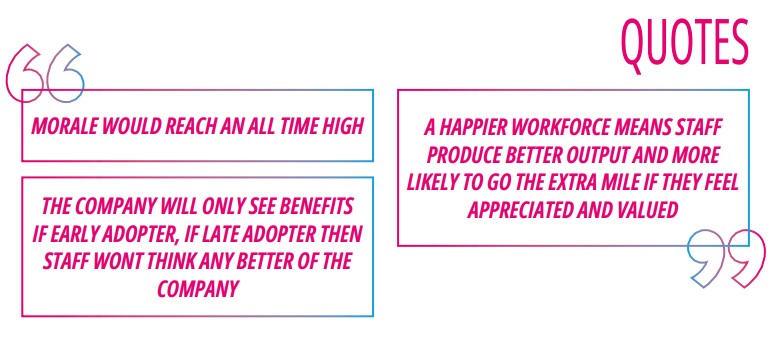
“TO ENSURE THE SUCCESS OF THE CAMPAIGN EVERYONE SHOULD GET INVOLVED. ARM YOURSELF WITH THE FACTS AND SPEAK TO YOUR COLLEAGUES, A CHANGE ON THIS SCALE CAN ONLY BE DELIVERED BY ALL OF US WORKING TOGETHER”

INTRODUCTION
For some time, the popular conception of the length of a full-time working week has barely changed. While the traditional Monday to Friday, 9-to-5 model has evolved over the years to meet the needs of businesses and customer expectations, a full-time job in the UK continues to average around 37 hours a week.
Of course, at one point the working week was longer. In 1952 a full-time job in the UK would typically require 48 hours a week which itself was a result of trade union struggle over many years.Interestingly, it was Henry Ford who popularised the 40 hour week in the US. He was no friend of trade unions but found that reducing the week from 48 hours boosted productivity.
Historically, working hours have tended to reduce over time, but not over the last 30 years. While businesses are striving to make more and more efficiency savings through the adoption of new technologies, it is surely time to demand that these are also used to improve the conditions for staff, including reducing the length of the working week for no loss of pay.
EVIDENCE
A 2023 report from the think tank Autonomy and leading academics at the University of Cambridge and Boston College in the US published the results of a six-month trial where 61 employers meaningfully reduced the length of the working week while maintaining 100% of the pay.
- The results were startling:
The vast majority of companies were satisfied that business performance and productivity was maintained - 71% of employees reporting lower levels of
burnout - Reported levels of anxiety, fatigue and sleep issues decreased, while mental and physical health both experienced improvements.
- Respondents found it easier to balance their work with both family and social commitments, and were more satisfied with their household finances, relationships and how their time was being managed.
- Companies’ revenue stayed broadly the same, rising by 1.4% on average. When compared to a similar period from previous years, organisations actually reported revenue increases of 35% on
average - There was a substantial decline (57%) in the likelihood that an employee would quit, dramatically improving job retention.
- There was a 65% reduction in the number of sick days
- Almost every company (92%) that took part has decided to continue with the four-day week after the pilot
MOMENTUM
More and more employers are experimenting with a reduction of hours for no loss of pay across the private and public sectors, here and abroad. The body of research evidence is growing that shows the positive impact it has on workers’ finances as they save money on travel and childcare, as well as their mental health.
Its success has also captured the attention of politicians. In the USA, Bernie Sanders introduced a bill in 2024 to reduce the standard working week to 32 hours while maintaining pay and benefits. In the UK, Peter Dowd MP introduced an Early Day Motion calling for further trials which was signed by colleagues from the Labour Party, Green Party, SNP and
SDLP.
What might once have seemed a pipe dream now has credibility and is gaining momentum. The call to employers must be to embrace a shorter working week now, lead your industry, attract and hold onto the best talent, and reap the benefits of a happier and more productive workforce.
CWU T&FS SURVEY DETAILS
An email link to an online survey was sent to every member in the Telecoms and Financial Services constituency working for companies who recognise the CWU.
The survey opened in December 2024 and closed in April 2025 and received a total of 9,496 responses. 92.5% of respondents worked full-time hours and 47.3% worked Monday–Friday.
The survey received a high level of additional comments – some of these are included in the following sections.
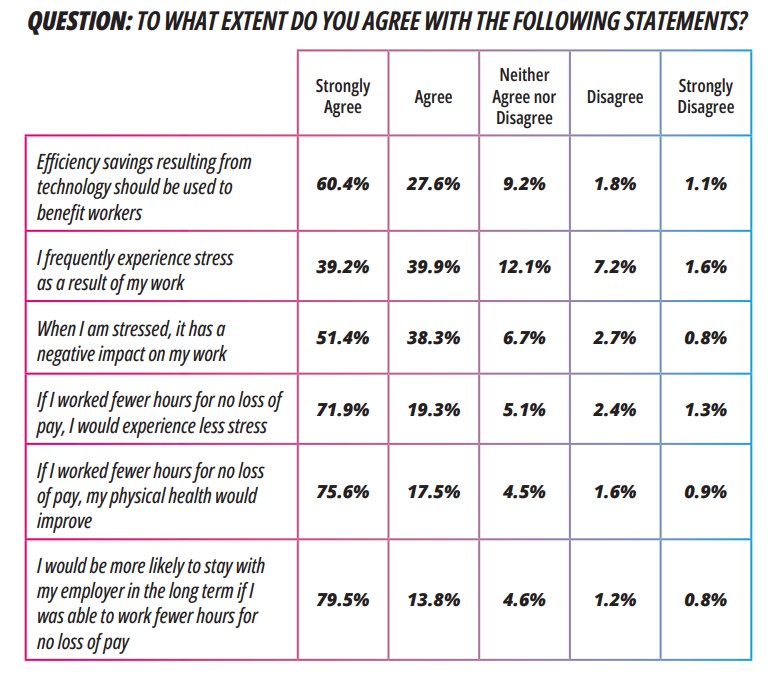
These questions sought to discover members’ experience of stress in the workplace and the extent to which they would see a reduction in hours for no loss of pay as helping to address that. 79% of respondents either
agreed or strongly agreed that they frequently experienced stress as a result of their work, with 80% believing that stress had a negative impact on their work- an indication that, beyond the standard care you would expect from a good employer, there is clear business interest in addressing this problem.
Furthermore, with 93% agreeing or strongly agreeing that fewer hours for the same pay would improve their physical health, 92% agreeing they would experience less stress, and 93% saying they would be more likely to stay with their employer in the long term. In doing so, members have made a strong statement that employers are likely to experience benefits related to reduced turnover, sick absence and productivity with the introduction of a shorter working week.
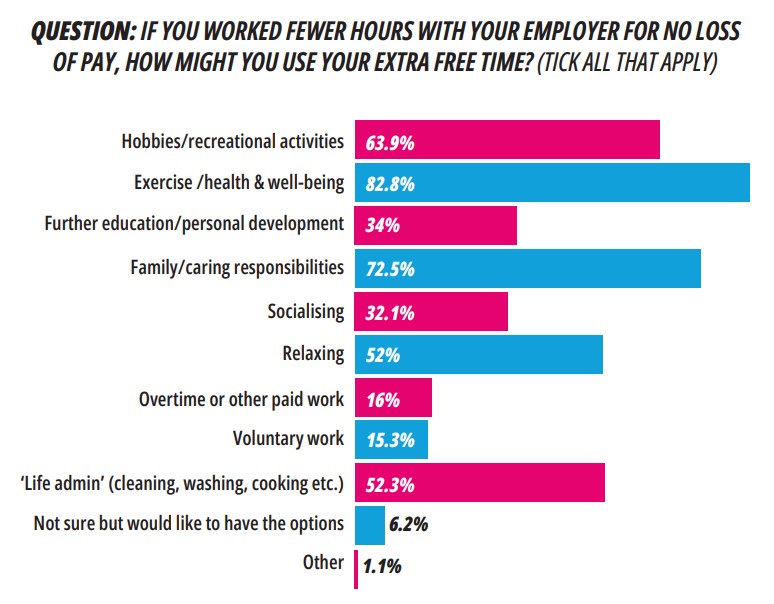
The answers to this question show how a shorter working week would lead to the benefits identified in the first question. The most popular response given was that workers would use that time to improve their physical and mental health. In addition, the second most popular answer was family/ caring responsibilities- clearly, making it easier or cheaper to care for loved ones will likely have huge positive impacts on workers’ mental health.
Of course, what people do in their own time is their business- there is no right or wrong way to spend it. However, there is a sense from these results that members don’t just want this time for the sake of it; this time could have a real positive impact on their lives and the lives of their families.
“I already volunteer and am a committee member for a non profit carers group. I could dedicate more of my time helping the unpaid carers community.”
“I help run a disability football team so having the time free would help me more time with the family and volunteering work.”
“Becoming a new father I need time to help my child’s development and have a more productive and meaningful impact on his future.”
“Would reduce the guilt felt of not being able to do it all – as a wife, parent helping elderly parents.”
“Any time off work would aid caring for my mother who is old and frail.”
“I am a mum and returning from maternity I am so anxious . This would help me so much with with looking after my son. I would work so much harder on the times I am in to make this successful as it would benefit my life outside of work so much.”
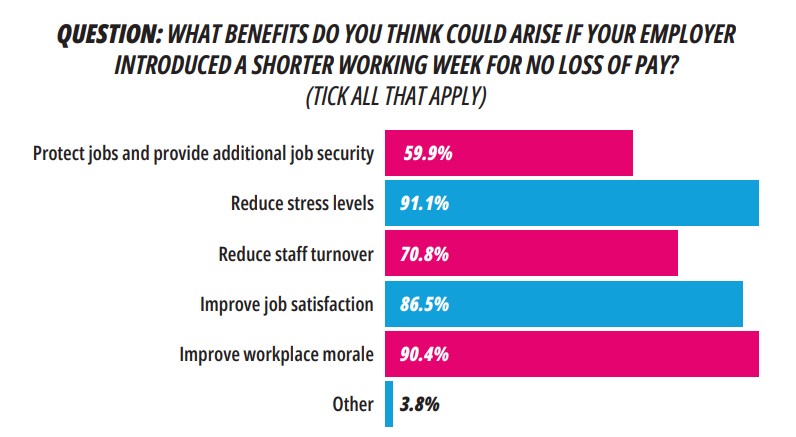
This question builds on the first by asking members directly how they think a shorter working week would benefit their employer. The answers indicate that the benefits that have already been seen in workplaces where this has been introduced are likely to also be seen in employers like BT, Santander, VMO2 and Capita.
Not only do members believe staff turnover would fall, the vast majority believe stress levels would fall which would result in fewer staff absences. In conjunction with the improved morale and job satisfaction members feel they would experience, this points to real productivity gains that could be made by employers, potentially saving money in the
longer term.
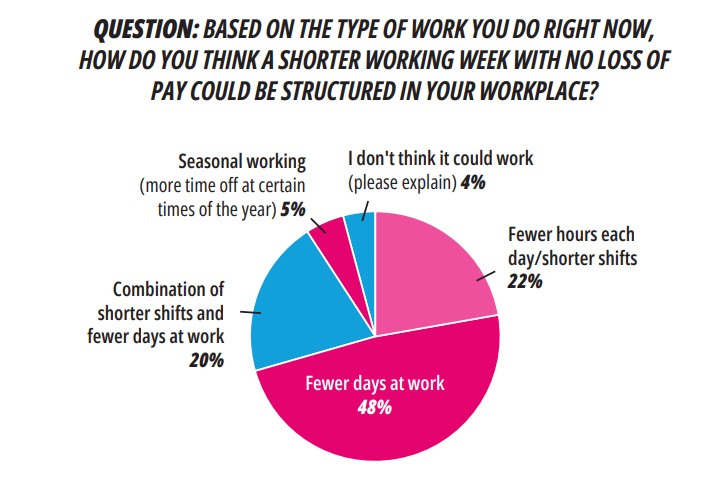
CWU members work in a wide range of job roles across different employers there is never going to be a one-size-fits-all approach to a shorter working week that will satisfy everyone and that should be born in mind in any campaign. Clearly, those that already condense their hours into fewer days may simply wish to reduce the length of their working day
That said, it would appear that many respondents see the value in spending fewer days at work, something that would make it easier to incorporate the rest, caring or leisure activity they might plan instead. It should be noted that while it has been a solution in other workplaces that have reduced total working hours, there appears little enthusiasm for seasonal working (fewer hours only at certain times of the year).
QUESTION: WOULD YOU BE IN FAVOUR OF A SHORTER WORKING WEEK FOR NO LOSS OF PAY AND SUPPORT A CAMPAIGN TO ACHIEVE IT?
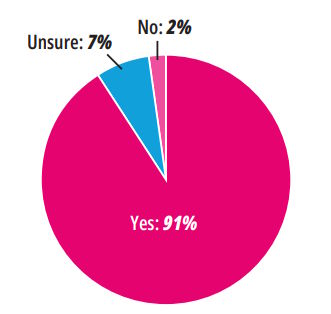
The overwhelming response shows how popular a measure this would be for members and is consistent with the answers to the previous questions. In addition, 1,911 respondents said they would be happy talking to colleagues to help promote any campaign on this to help make it a success.
“This is a truly life changing idea.”
“I am so passionate about this I would happily support the campaign.”
“I’ve been keeping an on the the 4 day working week campaign gaining steam over the past couple of years.”
“In the winter I never see daylight when I’m not working apart from weekends.”
“I want to see more of my son growing up.”
“I believe 100% a shorter working week for the same money has the potential to save lives.”
“My health is worth fighting for!”
“The thought of a 4 day work week perks up my mood and I so desperately wish this can be implemented.”
“Achieving this would be ground breaking and I would support it all the way.”
CONCLUSION
The survey results indicate that a campaign for a shorter working week with no loss of pay would be extremely popular among members. This will have to work differently in each company and across different types of work, but should nonetheless make a huge difference to their lives in terms of their health, happiness, and career and life goals. Members can also see how their happiness and well-being would benefit their employers too.
Furthermore, thousands of these members are prepared to take steps to help make this happen. This is important. For all the efforts the union’s negotiators can muster, for all the facts, evidence and powers of persuasion they can use with employers, it is only members who can deliver this. The more knowledgeable and vocal they are, the more they participate in the campaign and bring new people into it, then the more employers will see that the issue will not go away.
Next Steps
The Telecoms and Financial Services Department of the CWU is launching its shorter working week campaign with a view to getting all employers that recognise the CWU to adopt this policy. As a first step, companies should agree to establish pilots in good faith so that all parties can learn and establish its effectiveness.
To achieve this, the case will be made to individual employers from the workplace up. The case will be made that workers deserve to share in the efficiency savings made from new technology and that there are huge business savings to be made in productivity and staff turnover – everyone stands to gain from this.
At the same time, the union must also play a part in shaping the wider public perception around shorter working hours. A quick search online will reveal numerous news stories, examples of its successful implementation, and buy-in from local and national politicians. The idea is gaining momentum and will one day be seen as normal, in the same way that a 40 hour week is considered ‘normal’ today. In this kind of environment, it will become harder for businesses to resist change
At every stage, it is CWU members who will play the crucial role- whether it be writing to MPs, questioning their employer, or sharing
information with colleagues to get their buy-in. Over the coming months, a range of activities are planned where members in every workplace can harness their collective strengthand win.
This is an ambitious policy and change will not happen overnight. But things can change if members stay committed and make their voices heard loud and clear.
It is a campaign
whose time has come.